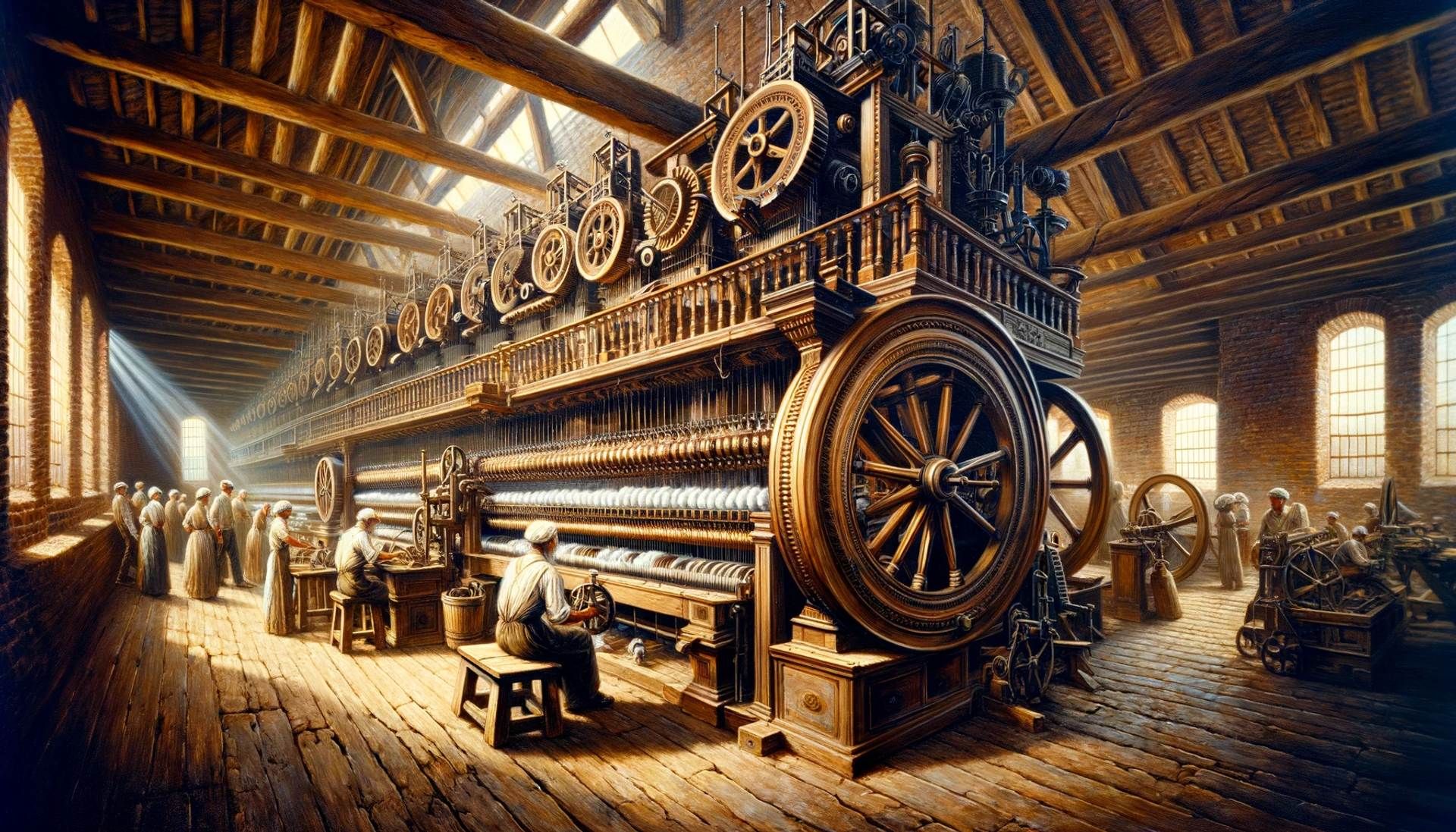
A nineteenth-century cotton-spinning machine, the kind of equipment that helped textile factories expand during early industrialization. © CS Media.
The Industrial Revolution began in England in the late eighteenth century, when manufacturers could use water- and steam-powered machinery profitably. The clearest early change appeared in cotton manufacturing. In spinning mills, owners gathered workers inside factory buildings so that spinning and weaving machinery could run for long hours. As those establishments produced more yarn and cloth, demand rose for coal and steam pumps. Canal promoters then had stronger reasons to connect industrial districts with ports and coalfields.
This transformation rested on a long technical history. For centuries, societies across Eurasia had used mills and furnaces, while skilled workshops had refined ships and precision tools. In England, however, older skills entered businesses that promised enough sales to cover costly investment. Cotton manufacturers could sell cheaper cloth in larger markets. Mine owners found buyers for coal. Creditors, in turn, could rely on courts and parliamentary rules that reduced part of the risk of financing machinery and transport works. Industrialization began when English producers could repeat a cycle of technical improvement, expanded production, and new investment.
How Factory Production Changed Work
Before the eighteenth century, many goods were still made in households, small workshops, or workspaces tied to farming and urban trades. Even when machines were used, they often stood near rivers or in dispersed workshops rather than inside buildings that concentrated hundreds of workers under the same discipline. In the new cotton mills, employers placed costly spinning and weaving equipment under close supervision and paid workers to keep it running for long hours. Factory work changed production because employers could control both the pace of labor and the use of expensive machinery.
In The Age of Revolution, the British historian Eric Hobsbawm described the Industrial Revolution as a break with older limits on production. He did not treat that break as the result of a single invention. A mill owner, for example, could install machinery powered by water or steam in order to produce cloth at lower cost. If the cloth sold, the owner could use part of the profit to enlarge the mill again. For Hobsbawm, industrialization made repeated growth a normal expectation for producers who could keep finding buyers.
Cotton manufacturing explains why mill owners wanted factory buildings. For a long time, spinning and weaving had been done in homes or small workshops. Merchants supplied fiber to households and later collected yarn or cloth for resale. Once machines became larger and more expensive, mill owners began to concentrate production near the power source and under direct supervision. That arrangement reduced workers’ autonomy, but it also made machinery easier for employers to monitor, repair, and use continuously. Factory production therefore increased textile output while strengthening employers’ control over the working day.
Useful Knowledge, Patents, and Industrial Invention
English mechanics did not invent industrial technology from nothing. Before the eighteenth century, many societies already used mills, worked metal, and built precision tools to solve problems in production and transport. In England, those older skills gained a different value when manufacturers were willing to pay for devices that saved labor, increased output, or made mining easier.
The Scientific Revolution and the Enlightenment made that technical repertoire more systematic. Learned societies and printed manuals gave prestige to experiment, measurement, and public discussion of mechanical improvement. In The Enlightened Economy, the economic historian Joel Mokyr uses the expression “useful knowledge” for technical knowledge that specialists could test, discuss, and apply to production. He argues that British artisans, engineers, and manufacturers increasingly treated such knowledge as a way to solve production problems and attract financial support. In Mokyr’s interpretation, improvement moved faster when a better pump, engine, or textile process could be presented as knowledge with commercial value.
A technical improvement still needed financing before it reached a mine or a mill. A mechanic who improved a pump, for example, needed metal and skilled labor. He also needed backers willing to wait until the device produced income. Patent law helped by giving an inventor a recognized claim: a patent turned a technical improvement into a right that could be licensed, shared with partners, or negotiated with investors. Many patented machines failed, and patents did not guarantee financial returns. Even so, the growing number of English patents from the seventeenth to the nineteenth century shows that more inventors and financiers treated technical change as a commercial asset.
Coal, Steam, and the Cost of Power
English producers turned to coal when industrial work demanded more heat and mechanical power than older energy sources could provide reliably. Forests regrew slowly, charcoal remained costly, and water power depended on the location of rivers. Several British regions, by contrast, had abundant coal deposits. Since coal concentrated more usable heat than wood, cheap fuel made energy-hungry businesses more attractive to mine owners, iron producers, and manufacturers.
Coal entered industrial production in two related ways. First, households, workshops, and furnaces burned it directly for heat. Second, coal mining created a problem that rewarded steam technology: deeper shafts and underground galleries filled with water. Early steam engines became commercially useful as pumps because mine owners could use them to drain those workings and extract more coal. Mine owners adopted steam pumps early because repeated flooding threatened a product valuable enough to pay for the equipment.
Iron production connected coal to machinery. Furnaces needed cheap fuel. Engine builders, railway contractors, and mill owners needed stronger metal. In districts where coalfields, ironworks, and workshops stood near one another, mechanics could move from one production problem to another. Stronger parts made engines more reliable; better engines drained deeper mines; more productive mines supplied cheaper fuel. In those districts, an improvement in one workshop could lower costs for another producer and make further testing easier.
Why Cotton Textiles Mechanized First
Cotton textiles gave English manufacturers one of the first branches in which sales could justify the cost of machinery. Families bought cloth throughout their lives, and cheaper cloth could reach buyers with different incomes. Cotton fiber could also be spun into fine yarn and woven into light fabrics; for that reason, an improvement in spinning quickly affected the price and quantity of cloth sold. Mill owners adopted machines when they expected cheaper yarn or cloth to sell in quantities large enough to cover the cost of buildings, engines, and equipment.
Hobsbawm gave so much weight to cotton manufacturing because Lancashire manufacturers could increase output and still sell the additional cloth. Machines raised the quantity of yarn and fabric. At the same time, merchants operating Atlantic routes brought cotton fiber from the Americas and sold British textiles inside and outside Britain. For Hobsbawm, this branch explains how each reduction in the cost of cloth allowed Lancashire manufacturers to sell more and then enlarge production again.
Lancashire’s expansion depended on violence beyond England. British merchants obtained much cotton fiber from enslaved plantation labor in the Americas and from other regions tied to imperial commerce. Enslaved or otherwise coerced workers produced an essential share of the fiber that English mills turned into yarn and cloth. Lancashire mills therefore depended on an Atlantic and imperial economy, not only on an English industrial district. That supply helped manufacturers keep producing; at the same time, early industrial growth became tied to colonial inequality and forced labor.
Cotton also challenged older producers inside Britain. Wool manufacturers and merchants had reasons to defend their trade, but demand for light and cheap cotton cloth grew during the eighteenth century. As spinning jennies, water frames, and later steam-powered mills increased output, cotton manufacturers could lower costs without exhausting demand. Inside the mills, managers and workers learned routines that later spread to other branches of industry. They kept equipment running for long hours, organized the day by the clock, and calculated whether future sales could pay for expansion.
How Enclosure and Rural Change Expanded Wage Labor
Industrialization also drew on changes in the countryside. Landowners and commercial farmers increased food output as they reorganized land use and invested in more profitable crops and livestock. At the same time, Parliament passed enclosure acts. Under those laws, common fields and open-field strips could be fenced or absorbed into larger holdings. The reach of enclosure varied greatly from one village to another. In many communities, however, rural families lost older uses of common land. They could no longer rely in the same way on grazing for animals, firewood, grain left after harvest, or small plots for cultivation.
When rural families lost those supports, some became wage laborers on larger farms, while others moved toward towns, ports, coalfields, and textile districts. Factory owners did not create those people’s poverty, but they could hire workers once older rural economies no longer supported everyone as before. Wage labor expanded through a double movement: employers offered regular pay, while many households had fewer ways to live without wages.
In The Making of the English Working Class, E. P. Thompson insisted that workers were historical actors, not a passive result of machines or enclosure. For Thompson, people who entered factories did not leave earlier ways of life behind. Many understood factory discipline through the worlds of craft, neighborhood, religion, and protest in which they had learned to work and act together. The English working class was formed as workers adapted to factory life, defended older expectations, and created new forms of collective action.
Capital, Credit, and Buyers
Anyone who built a mill, opened a mine, or promoted a canal had to spend money before receiving income. A mill owner, for example, bought machinery and paid workers while waiting for cloth sales to return the money invested. A mine owner opened shafts and installed pumps before selling coal in larger quantities. A canal promoter bought rights of way and paid for construction before collecting tolls. For this reason, industrial expansion depended on creditors and partners willing to exchange present money for future sales.
In England, people enriched by commerce, land, or Atlantic and colonial activity could place part of their money in industrial ventures. When a manufacturer wanted to set up a mill or a landowner wanted to open a mine, local banks could lend and investors could buy a share of the enterprise. Public credit made long projects appear less risky to people with money to invest. In that setting, money earned from land or trade could move more easily into mills, mines, and canals because England’s propertied elite was unusually open to commercial investment.
Expected sales made those investments more credible. Britain’s growing population bought more everyday goods. Meanwhile, roads, ports, canals, and later railways allowed manufacturers to sell beyond nearby towns. Overseas merchants sold British goods in Atlantic and imperial markets protected in part by British naval and political power. Therefore, a manufacturer who reduced costs could expect more than a small local gain. If merchants could sell cheaper cloth or iron to many buyers, financiers had a stronger reason to support the machine that lowered the cost of production.
Parliament, Property, and Commercial Risk
Industrial investment also depended on law and state power. Financiers lent with more confidence when they could use courts to collect debts, defend property titles, and enforce patents. After the seventeenth-century conflicts between Crown and Parliament, England developed a political order in which property and public credit received strong parliamentary protection. The system remained unequal and oligarchic, but groups connected to commerce and property had unusual access to lawmakers.
Parliament helped industrialization through specific decisions. When it authorized enclosures, it gave legal force to the reorganization of rural property. When it protected patents and contracts, it made negotiation easier among inventors, manufacturers, and creditors. When it maintained taxes and public credit, it sustained the navy and overseas expansion that protected part of British commerce. English manufacturers therefore operated in a country where law and policy reduced part of the risk of investment.
The English political order becomes clearer in comparison with parts of continental Europe. France, for example, had skilled manufacturing and technical competence under Colbertist policies. Still, a manufacturer who wanted to expand production could run into guild rules, privileges granted by the monarchy, or local charges on the movement of goods. English manufacturers faced obstacles too, but they more often found legal and political channels for turning commercial success into further investment.
High Wages, Cheap Coal, and Mechanization
Robert C. Allen explains early English mechanization by looking at the costs faced by employers. In The British Industrial Revolution in Global Perspective, he argues that relatively high wages and cheap coal made labor-saving machines more attractive in Britain than in many other economies. A manufacturer who paid high wages could save money if a machine reduced the amount of hand labor needed, and cheap coal lowered the cost of powering that machine. Allen’s argument explains mechanization through prices, not through inventors’ curiosity alone.
That explanation has limits. Wages varied by region, occupation, gender, and age, and many early factories relied on women and children who were paid very little. Employers also lowered labor costs by lengthening the working day and supervising workers closely inside the factory. For that reason, mechanization should not be confused with a simple search for humane efficiency. It often combined technical improvement with harsh working conditions.
Allen’s price argument still helps explain why the same machine could have different value in different places. In a region with cheaper labor, costlier fuel, narrower markets, or weaker credit, a machine might not repay its cost. By contrast, in England, many manufacturers could expect machinery to save labor, run on relatively cheap power, and help them sell more goods. Employers mechanized production when they expected savings in labor and power to repay the cost of the machine.
Why Industrialization Began Earlier in England
Comparison with other regions shows why England’s incentives had to appear together. Dutch merchants operated one of Europe’s strongest commercial economies, but the main Dutch industrial regions did not have cheap coal near manufacturing districts in the same way Britain did. French producers possessed skill and state support; even so, guild privileges and pre-Revolutionary institutions sometimes made expansion more difficult. In China and India, many producers worked within sophisticated markets and manufacturing traditions. In many settings, hiring more workers or improving existing workshops made more sense than buying expensive coal-powered machinery.
In The Great Divergence, Kenneth Pomeranz rejects the idea that Europe had always been destined to outpace Asia. He argues that advanced regions of Europe and Asia still faced serious land and energy constraints before the nineteenth century. Britain’s position changed when manufacturers could use coal near industrial regions and buy cotton fiber produced on American land. For Pomeranz, British industrial growth rested partly on domestic coal and partly on resources obtained through Atlantic and imperial connections.
English manufacturers encountered incentives that appeared more weakly or more separately elsewhere. A cotton mill could reduce costs, sell more cloth, and use part of the revenue to expand production again. That cycle of sale and reinvestment made the purchase of new machinery more plausible. Near industrial districts, coal lowered the cost of the mechanical power needed for that expansion. Creditors financed machinery and transport when they saw contracts and property rights protected. Rural change brought more people into wage labor, while Atlantic merchants supplied cotton fiber and searched for additional buyers. With this set of opportunities and pressures, English manufacturers had stronger reasons to buy machines before competitors in other regions did.
Conclusion
The Industrial Revolution began in England when mechanization became profitable there earlier than in other major manufacturing regions. Older technical knowledge contributed to that change only when mechanics, manufacturers, and investors could apply it to paid production. In cotton mills, expensive machines made sense when owners expected to sell more cloth. In mines, steam pumps made sense when they allowed owners to extract more coal. In canals, investment made sense when mills and mines needed to move supplies and goods. Behind those ventures, Parliament, courts, and naval power protected many commercial claims.
Industrialization also carried social and global costs. Many rural families became more dependent on wages as older subsistence supports weakened. Factory workers faced discipline, long hours, and dependence on employers. Lancashire mills used cotton fiber produced by enslaved or coerced workers in regions tied to Atlantic commerce. English industrialization emerged from that process: with credit and legal protection, manufacturers could hire workers, buy coal, and turn cotton fiber into cloth sold on a growing scale.